Sunday, March 22, 2015

Madrid Through Younger Eyes

Quinn takes on Cristiano Ronaldo at Bernabéu Stadium

For me, Madrid is an adult city offering art, history, remnants of an ancient past, classical guitar, flamenco, its own look and style. I worried about its appeal to my younger grandchildren when they arrived with parents in February: my son Joe, wife Shannon and the grandchildren, Campbell, Quinn, Parker and Tanner ranging in age from 17 to 10. I had so looked forward to introducing them to the city and to Spain in general. 

Having studied the habits of fellow travelers and benefiting from the experience of any and all, I try to learn a bit about the places I visit: history, architecture, art, archaeology or nature; to experience the place through sound, sight, smell, taste, touch; and to seek experiences that make the place memorable. I followed that guide to develop an itinerary for Joe and family, knowing we would substitute, rearrange, delete whether for mood, whim or weather. 
Puerta de Alcalá: Quinn,
Tanner, Campbell, Parker


Prosperidad, Prado 


We began with a sleep-deprived walk through our barrio, La Prosperidad, then lunch of tortilla, the Spanish potato and egg dish similar to frittata that we get from a neighborhood source Rich discovered. The next day, we ambled through old Madrid sites, Plaza Mayor the center of the old town and  to Puerto del Sol, which marks the center of Spain and center of the city. 

We toured the Prado with grandchildren each holding a list of recommended paintings to find. I tried an introductory short lesson on what to look for in the paintings: Does the painting look like a photo? What does it tell you about history? Does it show how people dressed? Does it show royalty or regular people working or playing? Is it a landscape with or without people? What recognizable traits might help you identify the artists? I used a guidebook from the Prado for illustration, and encouraged the kids to stop to look at anything that attracted their attention. The Prado is immense, and we have learned to limit our sessions to two hours and schedule a meeting place. When I met Quinn roaming through alone, he had just found Rubens' “The Three Graces” and others both on the list and in addition to it. Together we located Velázquez, “Las Meninas,” and looked at details that make the piece great. Then Quinn elected to go off alone in search of more art to mark off his list. 

Palacio Real


El Palacio Real, built by Felipe V (1683-1746) with 2,800 rooms,
functions for formal ceremonies. Giambattista Tiepolo's frescos
decorate the ceilings, at times spilling down over the crown molding.
 

El Palacio Real detail


We toured the Palacio Real, luxurious and elaborate amid elbow to elbow crowds. We waited in line for chocolate and churros at San Gines and stood at the counter to drip chocolate-coated churros from cup to mouth. We ambled through Retiro Parque where the kids seemed more interested in the food stands than in the puppeteers and musicians and magic shows and rowboats on the lake. We spent an evening of flamenco at Las Carboneras. 


Toledo


Toledo's Moorish details
We traveled to Toledo on the bus. Toledo soars beautiful on its high mount, more stunning with distance than within. Busy with shoppers, it resembles old Barcelona  more than the smaller medieval villages. The Alcazar rises majestically on the wall edge, part of the town’s fortifications. 

The cathedral sits tucked into narrow streets, the top impressive from a distance, but less so closer because the structure crowded within narrow streets has no viewing place, no way to see it whole and massive. Inside, thick, multi-ribbed columns create a  forest reminiscent of the Mezquita in Cordoba.


Toledo's Cathedral built on the site of a mosque

Cloisters in the Cathedral 

 I followed the Rick Steves guide from high altar to lovely window cut through the ceiling to channel the morning sun. I treaded through the impressive gallery to see art by El Greco, Goya, Caravaggio, Velazquez and more. The cloister outside is in mid-stage of refurbishing frescos, soft and colorful under the arches.


Bernabéu, Biking and Rope Play

Joe’s family shared three obviously favorite activities in Madrid: shopping, Bernabéu Stadium and biking along the Rio Manzanares. They shopped in Corte Ingles and throughout that central shopping area; they spent a late afternoon and evening shopping in Chueca’s boutiques, and they shopped in Toledo. The prices in Madrid and the extended post-Navidad sales are definite attractions. 
Campbell, Shannon, Joe and Parker take a break
at the top of El Corte Ingles


They also enjoyed touring Bernabéu Stadium, playing ground of Real Madrid fútbol (soccer). The stadium museum is high tech with video embedded light tables where photos can be moved and changed at whim. With the tap of a finger you can watch videos of past games. Screens project life-size players with stats and bios. In addition, the self-guided tour includes visits to the turf and team box, team dressing room, VIP seats, and lots of photo opportunities. I would highly recommend this tour to soccer fans of all ages.
Real Madrid bench: Parker, Campbell,
Quinn, Tanner, Joe


Quinn at Bernabéu

Campbell and Quinn at Bernabéu

Tanner and Parker at Bernabéu
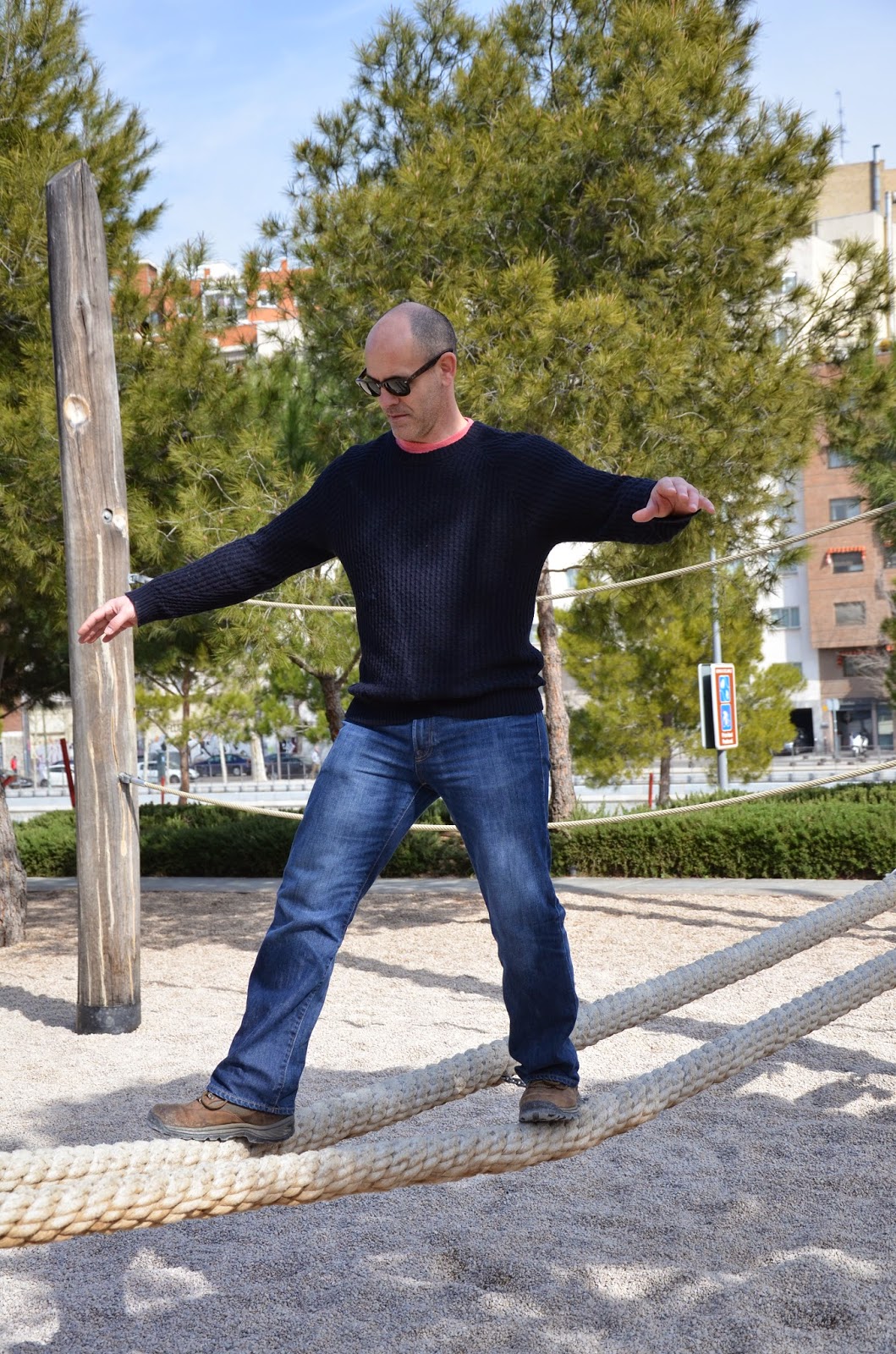
The family also enjoyed biking along the Rio Manzanares all the way to Atlético Stadium in south Madrid. All four kids elected to ride karts, four-wheel, low slung bikes that take their toll on thighs. Joe, Shannon and I selected 6-gear regular bikes with baskets. We made multiple stops for the rope play areas: high ropes to walk across with assistance, low ropes to test balance, robes to climb and ropes to swing across. It’s a marvelous playground with appeal from 10 to 50 and beyond if you don’t fear falling.

Campbell on the ropes

Parker 

Joe 

Tanner in the sky box
As usual, we exposed them to an array of Spanish cuisine, from paella to jamon and Manchego cheese to chuletón (steak thinly sliced) cooked at table at our neighborhood Casa Vicente, to bocadillos (Spanish ham or ham and cheese on baguettes). Food always gets attention. A busy week for all.

Thursday, February 12, 2015

Roaming Madrid

Rio Manzanares with Teleferico cars above and Santa Maria la Real de la Almudena Cathedral
in the distance

Seeking Solo Adventures

Rich was in the U.S. for three weeks recently, so I truly rambled solo. The first week was perfect; I love having alone time to do exactly what I want within reason without compensating for a companion, even one I love. You know the drill: eat when and what I want, go where I want...etcetera. 

It was definitely a boon for my Spanish speaking, not my strong suit and Rich has no problem speaking -- in any language. I walked about the apartment talking aloud to myself and felt the need to stuff caramels in my mouth on the street to quell the incessant chatter. I formulated questions and comments for waitresses; I translated witty comments for bartenders; I entered tiendas (small shops) to inquire about té negro con fruta (tea with fruit) or aquellas botas en la ventana (the boots in the window). I still have Spanish class four hours a day, Monday through Friday, and speak English to a fellow student from England during our 30 minute break. My mind roils in constant translation. The persistent problem is that I invent new Spanish words in my dreams and spend nights trying to translate these nonsense phrases. ¡Qué horror! 

Rich with better Spanish listening skills than I, usually responds to the occasional language challenge. During his absence, The water meter reader arrived at the door and let go a staccato of words. Reacting to my blank stare, he slowed the short burst somewhat. Realizing that, too, wasn't working, he simply said, "Agua!" That and the uniform got him in the door. At least, I know where the water meter is.


Click once or twice on any photo to enlarge the image.

Santa Maria la Real de la Almudena Cathedral
houses the Almudena Virgin attributed to
Diego Copin of Toledo (16th C.) and known
as the Patroness of Madrid.
Ermita de San Antonio de la Florida


Almudena Cathedral cupola
 Almudena Cathedral window
Almudena Cathedral detail

Off the Tourist Track

After multiple visits to Madrid I've seen many of the major tourist venues; visitors give me opportunity to go again. One advantage of living here is the time to explore the less touted places. My recent solo rambles have included Santa Maria la Real de la Almudena Cathedral (constructed 1885-1993), which sits beside the Palacio Real, a major city site. Stunning frescoes of Francisco de Goya plus his remains, minus the head, reside at Ermita de San Antonio de la Florida. Both sites are lovely surprises in their beauty and simplicity and almost touristless. I also visited the Museo de América with a group from AIL Madrid, my Spanish language school. We rushed the visit because we arrived an hour before closing, but that was enough to get the gist of the museum, an interesting venue for native Indian objects from the Americas extending from Tierra del Fuego in the far south to the Arctic.

Outstanding in the Almudena Cathedral, completed in 1993, are the ceiling of multicolored panels that resemble kente cloth from Africa, the stained glass windows in geometrical designs, the contemporary flavor of the sculpture and other art, and the peace of the interior on a rainy Sunday afternoon. However, one madrileña finds the building itself a disaster with no grace or majesty (my words; hers were in passionate Spanish accompanied by hand gestures and facial grimaces.)

I recommend the Ermita first for the stunning Goya frescoes in the cupola and surrounds. The colors are soft and clean and vibrant. As in a recent exhibit at the Prado, Goya's models include nobles and common folk of the day. The ceiling in the Ermita is playful with children draping a curtain for hide and seek. The story goes that Goya's head was taken by scientists for study when the body was interred in the Ermita. Venture into the Prado's tucked-away room displaying Goya's dark work, such as "Saturn Devouring His Son," and understand the compulsion for the brain study. 


Granddaughter Emily walks the line
Rio Manzanares
One additional reason to trek to the Ermita is its close proximity to the pathway along the Rio Manzanares offering walking or bike riding. And for children of all ages, the playground on the west side of the Rio offers adult-sized seesaws, climbing structures and high rope walks to test your balance. 
Emily and her mom, Heidi, on the seesaw 

Other recent ramblings include: National Archaeological Museum and a lovely guided walk on a cold, sunset brightened late afternoon in search of the Austrian/Habsburg influence in Madrid, also a complement of AIL Madrid.

From Telly to Oscar

On the exploration side, I've begun to watch Spanish television news. Here, prime time begins at 10/10:30 p.m., the news at 9 p.m. With my bedtime at 10:30, TV is not truly an option. However, I have seen movies that would never make Rich's list. A few
One of those Austrians Philip III, in Plaza Mayor,
was honored for transforming the once medieval
market into a Baroque plaza
theatres show films in original language with Spanish subtitles, and thus I've seen "Siempre Alice" (always Alice or "Still Alice") with Julianne Moore, Oscar nominee for best actress, and "Into the Woods" with Meryl Streep as the bruja, nominated for best supporting actress. Anyone--Joe Burch--with a love of the dark, dark Grimm's fairy tales and an overall knowledge of the tales, needs to see "Into the Woods." I love the songs in English with Spanish subtitles; I love the dark side of the fairy tales; I love the literary comparison to Shakespeare's
Puerta de Alcalá near city center towers over traffic
and flowers blooming in February.
 
characters who go to the woods where magic happens--"Midsummer Night's Dream." It's an adult fairy tale with no promises in the end. (An aside: Just learned in class that Spanish fairy tales end with the line, "
El resto de sus vidas son felices y comen perdices." [The rest of their lives are happy and they eat partridges.] "Felices" and "perdices" rhyme. Gotta love this.)

From the other side of the movie pendulum, "Still Alice" tells the horror story of early onset Alzheimer's disease and its affect on a brilliant linguist and her family. Sad, sad sad. I have also seen "Alma Salvaje" (wild soul or "Wild") and "Birdman." I am fascinated by the Spanish translations of the titles, but can't explain why some titles are translated and others not. The Pacific Coast Trail is the real star of "Wild," from the Mojave Desert to the rain forest scenes in Oregon. "Birdman" gets the honor of the moment as the most interesting creation, but I was only convinced after The End. Although firmly set in New York City, the film reflects the influence of much Hispano American literature with magic and fantasy weaving through the action. I would be very tempted to look for other films from the Mexican director and co-writer, Alejandro González Iñárritu. I recommend all to avid cinema goers depending on likes/dislikes, but be forewarned, I'm an avid attendee with little discrimination for all Oscar nominees.

I also watched on CD "El Secreto de sus Ojos" (2009) in Español, no subtitles available. Amazing how much you can understand from expressions alone.

At the end of my solo ramble, I felt satisfied that I had continued to entertain myself, but I was so bored with my one on self discussions. Any conversations with depth were carried out via Skype, not exactly an intimate vehicle. As much as I love this city, without close friends, without heart-felt conversations, it can indeed be lonely. I love this adventure, but I do miss you all and am happy to have Rich home. 

Friday, January 16, 2015

Vagabond Wonders and Woes

Drop-dead gorgeous view from the terrace of the house in San Agustin de Guadalix, north of Madrid

Barcelona

In the midst of our two-week holiday together, Rich, my son David, Heidi, Emily and I ride the high speed AVE train from Madrid to Barcelona across rolling hills, gullies and canyons, mountains in the distance and glimpses of the sea when we near Barcelona. (The AVE train sells the best bocadillo -- serrano jamón and Manchego cheese on warm, crispy baguettes.) We arrive in late afternoon and settle into our apartment in the Barri Gòtic, the old section of the city. The apartment has two bedrooms, two tiny bathrooms, kitchen open to large living, eating area with futons for additional sleepers.The ceilings are probably 5 meters high, wooden slats and beams. The rooms have long windows with door-sized shutters that completely eliminate light and most noise from outside. With the shutters open, we can look up through the narrow chimney between buildings and see blue sky. An updated space perfectly in keeping with its medieval foundation. 
Barri Gòtic


[Enlarge photos by clicking in the center. To better see links embedded in the posting, go to the actual Rambling Solo site.]


Outside the apartment, narrow stone roads snake through corridors shadowed by the surrounding stone buildings. I lead the way in search of sardana dancers said to appear in front of the cathedral at either 6 p.m. on Saturday or noon on Sunday. Sardana is a circle dance and a Catalan tradition, forbidden during the Franco years, but quickly reinstated after his death. Although the dancers never appeared during our visit, the YouTube link provides several examples as well as showing "castles in the air," the tradition of building towers of people.
Cathedral in Barcelona
sin sardana


Barcelona, with rear of
history museum towering above

Barri Gòtic
 

And so we walked The Ramblas, the swath of walkway leading from Plaça de Catalunya with its fountains and city center bustle to the tall, slender Columbus Monument at the port. The Ramblas offers a kaleidoscope of entertainment along its sweep, from human statues of silver men or golden women to monstrous creatures inviting small children to pose for photos. There are outside cafes and pickpockets, balloon sellers and T-shirt vendors, sellers of birds in cages and flowers in tissue, and more tourists speaking more languages than almost anyplace else in the world. Barcelona is an international tourist mecca, compared to Madrid, the quintessential Spanish city. 
Las Ramblas


Port in Barcelona


We select the Museu Picasso and the Museu d'Història de la Ciutat for Sunday since many museums are closed on Mondays. (Note the spellings for museum. As you may know, Barcelona speaks Catalan -- museu; museo is Spanish; and spell check throws up her hands in disgust.) The Picasso museum has many of the artist's works created before he moved on to Paris and restructured the face of art, literally. The museum provides an educational introduction to Pablo Picasso through his very early work, including those completed at 15/16 years old: the portrait of Picasso's mother and "Science and Charity"As you walk across the room in front of Science and Charity, the bed lengthens and shortens depending on perspective. How many 16-year-olds know the meaning of perspective, much less how to create the effect in a static work? 
Columbus points the way
The viewing tower under Columbus is accessible
from the visitor center at the base.


We see portraits of Picasso's father, many of his assistant Jaime Sarbartés and self-portraits created over the years. We see the influence of Toulouse-Lautrec, several pieces from Picasso's Blue Period, but none from the Rose Period, other than one that hints of those rosy glows to come. One of my first-to-recognize and favorite Picasso pieces is from the Blue Period, Woman Ironing and hangs in the Guggenheim in New York.

Finally, the early hints of cubism appear, including one large room dedicated to Picasso's famous studies of the Velazquez masterpiece, Las Meninas, in the Prado in Madrid. The full rendition of Picasso's Las Meninas hangs with multiple individual studies. For the full perspective, I suggest a trip to Madrid and Barcelona; we're here until May. And if you come, we'll also see Picasso's famous, Guernica, in the Reina Sofia, here in Madrid.
Rich, David, Emily, Heidi at the port in Barcelona
with Park Güell visible on the hill behind

We move on to the Barcelona history museum recommended by new friends met at a Boxing Day party in San Agustin de Guadalix. New and very beautiful, the museum flaunts lots of wood, lovely displays of artifacts, and is airy and spacious, but the very best part is underground -- an archaeological site beneath the palace and cathedral next door. It's an extensive site with walkways rambling throughout, railings that don't interfere with the view, at times glass/plexiglass underfoot to reveal the dig. Captions are a bit uneven, sometimes including English along with Catalan and Spanish, sometimes not. The site itself is incredibly impressive; a Roman Barcino (working class community) (10 B.C.) unearthed beneath standing city monuments. Along with the footings for living quarters, the dig has revealed workshops for laundry and dyeing cloth, a swimming/soaking pool, fish processing and wine making vats. Then the walk extends into digs revealing the 7th century church and 11th century palace -- Barcelona in the Middle Ages. A fascinating walk through history.

More Barcelona next week.

These boats in Barcelona
headed around the world the 
next day
so Rich says

Immigration


In the months before we left the United States, Rich and I amassed the documents needed for long term visas to Spain. No, you don't need a visa to visit, but you do need one to stay for more than 90 days. We needed documents attesting to financial health; we needed signed assurances attesting to medical health; we needed police reports attesting to behavioral health; plus, photos, an apartment contract, and all the documents translated to Spanish and thrice copied. We turned it all over to the Spanish Embassy in August and returned to packing and disposing of belongings. 

Two weeks before our departure date in October, notification in hand, we appeared at the Embassy to have visas affixed to our passports. We were told to report to the police station in Madrid within the 90-day period. 

After three visits to a Madrid police station (closed; schedule an appointment; appointment) the experience was feeling much like DC rigamarole. Then, we were sent to a website to complete another part of the task. Rich spent days trying to decipher what to do and where to do it. Phone calls were unsuccessful. He finally traveled across the city to receive a small front-and-back form again citing a website where we could set an appointment. The response to the submitted e-form: no appointments available before your visa expires. With January plans to return to DC for a pre-scheduled court appointment, Rich was quickly becoming very grouchy. I began making mental plans to move to Chile. Rich called a Spanish attorney. 

Finally, we had an appointment overshadowed by clouds of pessimism. You are late; you needed this the first month; lots of people want to get into Spain; you are late. I could go to Chile and study Spanish. We ride the crowded Metro for an hour, packed among commuters returning to work after lunch/siesta, students headed home, standing room only for most of the trip. We disembark and begin a long walk along a highway in an industrial area of the city. I don't see any buildings that could possibly be a national police station. And we're late. On our left, a 4-story yellow block with blue canvas awnings, ugly, deserted on the street side, we follow a group in business dress around the corner and the building opens into a fenced courtyard where people in two long lines wend their way and police officers mill about. A woman smiles and waves from the security enclosure and whisks us through the human scanner, by-passing the belt scanner. A young man has held our spaces in line while the attorney herded us. She briefs us again: we are late; we needed this appointment a month ago; lots of people want to be in Spain; we may be refused. Santiago is a real possibility. "You have your photos," she says. I see the envelope left on the corner of the dresser in the apartment. I squeeze through the line and hie to the photo booths, slide in my 5 € note, push any buttons and retrieve a sullen-faced digital replica.

I focus on Chile where it is summer and scan the queue. The young Asian man who held our place in line is behind us. Women with small children, families, a mix of nationalities, skin colors and dress, mostly young, a few middle aged, all wait patiently to enter the building. Inside, walls of white glass tile, stark and cold, and around the perimeter, officials sit at 20 or so small tables with computers and interview applicants. I imagine a prison intake room. I look at the faces, stern, intent, sullen, bored, stern. Only one woman leans forward across the table, listening, eye to eye with her applicant. We don't get her table. 

Our official keeps her eyes on the computer screen, desk, papers, asks no questions, reaches for the passports. She places a small machine in front of me and indicates how to put my index finger on the screen, then again, roll side to side, then the other hand. She retrieves a letter from the printer, hands it to me and waves me on to another table while she turns to Rich's hand. The next woman chats with the attorney, stamps and initials my letter and returns it to me with a smile. I am an immigrant for a year. No fanfare, no hassle, clean, quick in the end. Chile will have to wait. Today aún, we have Madrid.

Saturday, January 10, 2015

On the Road to a Happy New Year


Cathedral of Salamanca looms through the fog

Road Trip to Segovia, Salamanca and Ávila

Son David, Heidi and Emily arrived 20 December, and we spent two weeks traipsing across Madrid, driving to Segovia, Salamanca, Avila, via train to Barcelona, via bus and cab to Pamela and Juan's Boxing Day party in San Agustin de Guadalix; we've eaten pounds of jamón and cheese and olives, shopped in the narrow, winding streets of Chueca in Madrid and Barri Gòtic in Barcelona and elbowed through the crowds at El Rastro flea market. We beat time to flamenco at Casa Patas.

 [All photos can be enlarged with a click in the center]
El Rastro wares

We zigzagged through the snow-capped Sierra de Guadarrama mountains to Segovia where the towering 2,000-year-old Roman aqueduct rises 30 m high and 825 m long and never fails to amaze even after multiple visits.We arrive just in time for lunch, and Rich finds a sunny spot in Segovia's Plaza Mayor where we each eventually shed winter jackets. Bean soup and lamb stew and duck leg and salad -- perfect for a winter afternoon outside. We explore the flamboyant Gothic cathedral topped with a Renaissance dome. The Gothic arches overhead collect any heat that happens into the structure, while at floor level, we tour in finger-numbing cold. At 1,000 meters, Segovia looks out over the surrounding countryside all the way to the Sierra de Guadarrama snow caps. The town is crowned by the Alcazar, a best in fairy tale castles--turrets and moat and high above the peon world.


Bean soup with clams in Segovia
Tall conifers
 in the Sierra Guadarrama
Aqueduct  in Segovia
We drive on to Salamanca that night with gusts of impenetrable fog spilling from the rolling farmland out across the road. We follow taillights hoping the driver ahead knows the road more surely than we. Then we follow a befuddled GPS through narrow winding streets, and finally abandon David with the Peugeot and tote all manner of bags down a pedestrian passage to find Hotel Rua. On this my first visit, the golden- toned stone blocks of Salamanca remind me of Oxford, which I visited more than 30 years ago, meaning memory, in truth, might be foggy. The cathedral, includes, relatively speaking, old and new spliced together; the old is 12th century Romanesque; the new (1513-1733), Renaissance, Gothic and Baroque. Fun to note, the same architect created the flamboyant Gothic exteriors of both cathedrals in Segovia and Salamanca according to one source. Both rise frilly and decorative toward the heavens. The University of Salamanca, established in 1230 and the oldest in Spain, originated in the cloister of the old cathedral. You can stand in the room and feel the tension of long ago students tested orally by the teacher/priests using an all or nothing scoring system.
Heidi, Emily and David with the
fairytale Alcazar in Segovia


Then on to Ávila, where I finally get to tour the first Gothic cathedral in Spain. Although begun as Romanesque, the cathedral was completed in the Gothic style in the 16th century. The gray block and  simplicity of the cathedral complement perfectly the medieval tapestry  of the walled city.
David and Emily

We loved sharing Spain with David, Heidi and Emily who go anywhere, eat anything (don't miss the final photos). While the rest of us relaxed somewhat between jaunts, Emily wrote college essays and submitted applications. Having the opportunity to read so much of her writing made this writer's heart proud. However, waiting to hear the outcomes in May might prove a bit nerve wracking. Plus, we have bets on the outcomes. Look for more on our travels in future posts.


Plaza Mayor in Salamanca 

 Feliz Navidad y Año Nuevo

Spanish class was my best source for Spanish and madrileño traditions for the holidays, but if readers have corrections and additions, please do add to the comments. Although Christmas here is essentially preserved as a religious holiday, not a gift-giving extravaganza, the streets are certainly full of shoppers and sightseers and families, and Christmas kiosks pop up in any available space. The markets sell toys, trinkets, inexpensive memorabilia, but they also offer nativity scenes or the individual pieces for do-it-yourself scenes. They offer Christmas decorations like Santas and stars and sparkle, but stands also display lots of mistletoe, potted evergreen trees and cut greens, and yards and yards of moss. We deduced the moss must serve as landscapes for nativity scenes. We are talking real moss, not plastic soccer turf. 
Spanish class holiday photo

We five celebrated Christmas Day with a suckling pig roasted by a neighborhood restaurant and carried home. Emily and Heidi ate the ears, and I don't know what happened to the tail. We devoured the entire roast, succulent and delicious as promised, in two sittings.

Emily and Heidi share
 freshly spun cotton candy in
Plaza Mayor in Madrid
Although some here admit to courting Father Christmas, the real Madrid gift giving waits for the arrival of the Tres Reyes Magos (three kings) who arrive by Cabalgata (procession) and bearing gifts on Dec. 5. We skipped the extravaganza that terminates in centro Madrid at Plaza Cibeles, but all five of us loved the small replica procession of the Tres Reyes Magos in our barrio of Prosperidad with Reyes and kids in costumes throwing caramelos (candy) to hordes of kids and parents in the streets.  


Waiting for the parade
Costumes


Reyes Magos arrive in Prosperidad


On the night of Dec. 5, kids follow the custom of putting shoes outside the door or on the patio to be filled with candy and gifts by the Reyes. In store windows, shops displayed knee-high women's boots overflowing with boxes and treats.

On New Year's Eve, David, Heidi, Rich and I made our way via Metro to a neighborhood close to Puerto del Sol and the major celebration. As is the custom, we each carried our baggie of 12 grapes to consume within the first minute of the new year for luck throughout the year. We left Emily at home, nursing a cold, finishing another application and holding her own grapes. 

Wishing all of you happy uvas and a wonderful year to come!


Heidi and Emily se gustan
las anguilas


Eating eels